
The History & Legend of Ballyvolane
A Georgian Country House for a Lord Chief Justice
There is an inescapable air of frivolity at Ballyvolane - the name itself means ‘the place of springing heifers’ and is testament to the fertility, richness and natural diversity of the land on which the estate lies.
The story of Ballyvolane as we know it today begins in the turbulent years following the Williamite wars in Ireland, when vast areas of land changed hands and a new generation of landowners established themselves across the country.
Sir Richard Pyne and King Billy
The Pyne family’s association with Ballyvolane began with Sir Richard Pyne (1644–1709), a prominent lawyer and judge whose fortunes were closely connected with the rise of King William III, popularly known in Ireland as King Billy.
Educated at Oxford and the Middle Temple in London, Pyne was called to the Bar in 1669 and established a successful legal career in Ireland. Following the Glorious Revolution of 1688 and the subsequent Williamite victory over the forces of the Catholic King James II, Pyne emerged as a leading figure in the new administration.
In 1691, he was appointed Chief Justice of the Common Pleas in Ireland and, in 1695, was promoted to Lord Chief Justice of the King’s Bench, one of the highest judicial offices in the country. He held this position until his death in 1709.
These were momentous and often violent times in Irish history. Following the defeat of James II’s forces at the Battle of the Boyne in 1690 and the subsequent Williamite victory, extensive estates belonging to supporters of the Jacobite cause were confiscated and redistributed. This fundamentally reshaped landownership in Ireland for generations.
It was against this background that Sir Richard Pyne acquired Ballyvolane.
In 1702–03, Pyne purchased Ballyvolane for £696. The lands had previously belonged to Sir Richard Nagle and Edmond Barry before being forfeited and granted to Viscount Sidney. Pyne subsequently acquired the estate through the Commissioners for Sale of Forfeited Estates.
At around the same time, he purchased several other properties in County Cork, including Blarney, Ballinaneala and Ardra. He also acquired Great Codham Hall in Essex, where members of the Pyne family continued to reside well into the nineteenth century.
Sir Richard never lived to see Ballyvolane in its familiar Georgian form. He died in 1709, but his acquisition of the estate marked the beginning of the Pyne family’s association with Ballyvolane, which would continue for more than 250 years.
The Georgian House and the Pyne Family
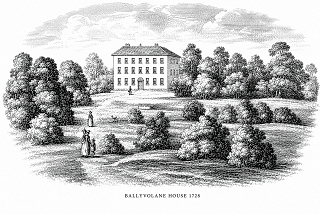
Ballyvolane House has traditionally been dated to 1728, when a classical Georgian country house of three storeys is believed to have been built on the site of an earlier building. The old estate book of 1847 contains an illustration showing the house before its later transformation.
However, more recent architectural research by Terence Reeves-Smyth suggests that much of the present house may have been constructed around 1800 by Arthur Pyne (1747–1839), who also laid out the surrounding parkland, which has a distinctly Regency character.
Arthur married Mary Masters of Castle Masters, near Macroom, and was succeeded by his eldest son, Jasper Pyne.
Jasper was a wealthy landowner who married three times and presided over Ballyvolane during a period of considerable prosperity. At its height, the estate employed more than thirty people in the house, gardens, stables and farm.
One particularly influential figure was Thomas Pennefeather, a relative of the Pyne family who came to stay at Ballyvolane for a fortnight and ended up remaining for forty years as estate agent. He was responsible for planting many of the magnificent mature trees that still define the parkland today.
The estate developed into an impressive country property, with extensive gardens, woodland, lakes, stables and productive farmland.
However, the family’s fortunes were not always straightforward.
When Jasper died in 1860–61, he left no surviving male heir. Under the terms of the family settlement, the property could pass only through the male line, meaning that his widow and daughters were unable to inherit.
Following a court case in May 1861, Ballyvolane passed to Jasper’s younger brother, the Reverend William Masters Pyne, Rector of Oxted in Surrey.
In March 1864, the Reverend Pyne placed Ballyvolane on the market through the Encumbered Estates Court. The property remained unsold until January 1869, when another member of the Pyne family acquired the house and demesne.
A few years later, Ballyvolane underwent its most dramatic architectural transformation.
The Italianate Remodelling of 1872
In 1872, George Pyne embarked on an ambitious rebuilding programme that transformed Ballyvolane from a three-storey Georgian house into the two-storey Italianate country house we see today.
The building was extensively remodelled, the top storey removed and a substantial west wing added.
Recent research carried out by architectural historian Terence Reeves-Smyth uncovered the original tender documents for these works, revealing that the architect was Richard Rolt Brash (1817–1876), a Cork architect whose father and brother were well-known builders in the city.
Brash was also a respected antiquarian and friend of the celebrated Cork historian John Windele. He had a particular fascination with Ireland’s ancient round towers and devoted considerable energy to studying the country’s early architectural heritage.
The alterations gave Ballyvolane much of its present character. Although generations of planting and changes to the gardens have continued to shape the surrounding landscape, the Italianate house remains the architectural centrepiece of the estate.
The Pyne family remained at Ballyvolane until 1953, bringing to an end more than two and a half centuries of association with the property.

The Green Family at Ballyvolane
In 1953, Ballyvolane was purchased by Cyril Hall Green, universally known as ‘Squirrel’, and his wife Joyce (née Blake), following their return from Malaya.
Squirrel had spent much of his working life managing rubber plantations in Malaya, where he had lived since the 1920s. On returning to Ireland, he settled at Ballyvolane, beginning the Green family’s association with the estate, which continues to this day.
Ballyvolane subsequently passed to Squirrel’s son, Jeremy Green, who ran the estate as a mixed tillage and dairy farm.
During the 1980s, Jeremy and his wife Merrie gradually diversified into hospitality, welcoming paying guests, or ‘PGs’ as they were known, and becoming founding members of Hidden Ireland, an association of privately owned historic houses offering accommodation.
Under Jeremy and Merrie’s stewardship, Ballyvolane developed a reputation as a welcoming and informal Irish country house, attracting visitors from around the world.
Salmon fishing on the nearby River Blackwater was an important part of the business. Ballyvolane operated several private fishing beats and employed ghillies to guide visiting anglers, many of whom returned year after year.
Following Merrie’s death, Jeremy handed over the running of Ballyvolane to his son Justin and daughter-in-law Jenny in January 2004.
Both Justin and Jenny had spent many years working in luxury hotels internationally, gaining experience at Mandarin Oriental in Hong Kong, The Legian in Bali and Jumeirah Beach Hotel in Dubai. Before returning home, Justin was General Manager of Babington House in Somerset, part of the Soho House group.
Since 2004, Justin and Jenny have continued to develop Ballyvolane as a family-run country house, combining the warmth and informality of a private home with the hospitality and attention to detail acquired during their years abroad.
Over the years, the estate has evolved to accommodate weddings, glamping, private events, music festivals and even its own gin distillery, Bertha’s Revenge, which operated from the old farmyard for ten years before the business was sold in 2026.
Today, Ballyvolane is entering another chapter, with a growing focus on private house rentals, residential retreats and intimate gatherings.
Through all these changes, Ballyvolane has remained first and foremost a family home.
Murder, Mystery and Buried Treasure
Of course, no Irish country house with almost three centuries of history would be complete without a few colourful legends.
One of Ballyvolane’s most extraordinary stories dates from the early eighteenth century and concerns an elderly couple, Andrew and Jane St Leger, their servants, a brutal double murder and a chest of treasure allegedly buried somewhere in the grounds.
The story, which also involves Joan Condon, has been passed down through generations and remains one of the most intriguing legends associated with Ballyvolane.
The full story of the St Leger murders and the legendary buried treasure follows here, as told in our original historical account.
Further Reading
Our great friend, historian and author Turtle Bunbury, has researched and written a fascinating history of Ballyvolane House, along with accounts of the families connected to the estate, including the Blakes of Menlo Castle, Joyce Green’s family.
We highly recommend exploring Turtle’s website, which contains thousands of wonderfully researched articles about Irish history, historic houses and the people who shaped them. Full access is available by subscription.
The Legend of a Witch, foul murder and a chest of buried treasure

(Taken from the book ‘Curious Tales from North Cork’ by Edward Garner).
To the east of nearby Castlelyons there is a cross-roads known as the Hag’s Cross, reputedly the scene of the last witch burning in Ireland. Since the presumed witch was a Joan Condon who died in 1731, then she could not have been the last. Over thirty years later an Alice Moran was incinerated in Limerick having been found guilty of poisoning one Joan Sullivan. Nevertheless, Joan Condon’s story remains an interesting example of fact and superstition becoming intertwined.
Nearer to Castlelyons stands Ballyvolane House, reached from the road by a winding drive affording lovely views of North Cork countryside on one side and bounded by a tree shaded shrubbery on the other. Nowadays, Ballyvolane is a pleasant single storey house, but in the eighteenth century there was an additional floor. Living there in 1730, having rented the house from the Pyne family, was the elderly Andrew St Leger and his wife, Jane. Like others of the ilk, the St Legers were in the habit of keeping most of their valuables in a chest stored in the principal bedroom. That trunk, the contents of which could mean an easier life for some, became the focus of attention of the butler, Timothy Croneen, and a maid, Joan Condon. The pair decided to murder the St Legers.
One dark November night the two crept into the principal bedroom and while Joan Condon held a lighted candle, Croneen plunged the knife into the throats of the sleeping couple. Grabbing the chest of valuables, the killers hurried from the house and buried it within the shrubbery. Then they returned, for their plan was to let it be assumed that the murders and robbery had been committed by strangers. And their plan at first looked like being successful.
Next day with the grim discovery of the blood soaked bodies a considerable cry was raised throughout North Cork and beyond. No suspicion attached itself to either the butler or the maid. However, matters started to go wrong on the day of the funeral. In those days it was custom for servants to ride on the carriage bearing the coffin of their deceased master or mistress, and so it was that Croneen and Condon joined the other Ballyvolane servants as the cortege left a day or so later for the churchyard at Aghern. A short distance behind the funeral carriage trotted Jane St Leger’s pet, which whined miserably in the wake of its dead mistress. Joan Condon’s nerves began to tighten as she watched the little animal. Croneen, noticing her mounting distress, slipped from the carriage and seized the dog.
Once the procession had passed from view he brutally slit the dog’s throat and hurled the body over a convenient ditch. To this day the spot is known as The Spaniel’s Cross.
Croneen caught up with the cortege and resumed his seat beside his accomplice. Curious to the spaniel’s disappearance, the other servants began to watch the butler and the maid with mounting interest, prompted by some unspoken suspicion. Eventually a ford was reached, but the horses pulling the carriage simply refuses to cross despite strenuous efforts by the drivers. Someone put a voice to suspicion by remarking that witches could not cross water. Joan Condon felt terror rising in her mind. Croneen, too, was more than a little troubled by the way matters were going. With much difficulty and frantic blows the horses were eventually persuaded to ford the stream; there were no further incidents.
Ballyvolane House, an Irish Georgian Country House photographed in the fities, now a historic Cork Inn offering luxury country house accommodation in Cork. After the funeral the servant’s suspicions about Croneen and Condon began to harden. No so quiet murmurings began to take bolder tones; some muttered the authorities might be well advised to look no further than Ballyvolane House itself for the killers of the St Legers. The same night Croneen and Condon, thoroughly frightened, decided to flee. Without waiting to dig up the chest in the shrubbery the pair made their way to the Cove of Cork. Once more the element of water entered the story. The murderers managed to secure berths on a vessel bound for France and thought themselves safe. Gathering fate moved when unexpectedly a storm blew up, denying the ship passage from the harbour. After unsuccessful attempts to reach open sea, the Captain decided to return to harbour and try again the next day. A decision that proved too much for the fugitives. Down the ships’ gangplank they scuttled and somehow managed to avoid capture as they made their way across country to finally reach the port of Limerick. It was there their luck finally ran out, being recognised by an observant official as the pair from Ballyvolane being hunted by everyone, and arrested them.
Both were found guilty at their subsequent trial in Cork. Croneen was executed and a little later so was Condon. She was sent to a place not far removed from the scene of the killings and, being thought a witch, was secured to a stake and burned to death. Where she perished was later named The Hag’s Cross and is still marked as such on some maps.
A few records have survived about the double killing of Andrew and Jane St Leger at Ballyvolane House. None contain any reference to witchcraft or to Joan Condon being a witch. What has almost certainly happened is that the murders and some quite separate episode involving the burning of a witch have become inextricably intertwined.
Andrew St Leger and his wife were murdered as they slept in their bed at Ballyvolane House on the night of November 4, 1730. Timothy Croneen entered the room with a pistol and shot St Leger. Jane St Leger he stabbed no less than eleven times with a sword. Astonishly she did not die for several hours. Croneen then returned to the servants quarters and, for reasons never explained, slew the gardener by driving an axe into his head. Robbery was the motive for these terrible crimes and somehow Joan Condon was implicated. On November 14 a reward was offered for the arrest of Croneen while the Lord Lieutenant added a further £100, announced by a proclamation:
“Offering for a reward for apprehending Teige alias Timothy Croneen, for the murder of Andrew St Leger, late of Ballyvolane in the County of Cork and Jane St Leger his wife, and for the robbery of the said Andrew St Leger”.
Not mentioned in the description of the crime were Joan Condon or the unknown Gardener. The proclamation was posted all over Munster and Croneen’s capture was inevitable, taking place at Limerick where he was spotted trying to board a vessel by a vigilant customs officer.
Croneen was taken to Cork where he was tried in January 1731.
By his side stood Joan Condon. In those times the slaying of a master or mistress by a servant was regarded as petty treason and as such the charge was not heard by a criminal court but placed before a special commission.
Sitting on this commission were James, Earl of Barrymore, Matthew Dea, the Hon James O’Brien, Henry Boyle, Robert Jocelyn, Anthony Jephson, Redmond Barry, William Maynard, Edward Corkery, Hugh Dickson, Noblet Dinscome, Stephen Moore and Bart Purdon.
Prosecuting was the attorney General for Ireland. Both accused were found guilty on January 15. Officials hurried Croneen out of the court and bundled him into an awaiting dung cart which hurried him off to Gallows Green where he suffered death by hanging, drawing and quartering. Later his head was spiked on the wall of the city gaol as a grim warning to others. A few days later Joan Condon died at Gallows Green, but whether or not by the same ghastly method is not recorded.
Today Ballyvolane House retains one tangible evidence of the murder of the elderly St Legers. When the house was being renovated in the last century, and reduced by a storey, bloodstained floorboards were discovered in the principal bedroom and it has proved impossible to remove them. Whether or nor Croneen and Joan Condon buried the St Leger valuables is questionable. However, Ballyvolane can boast possibly the best dug over shrubbery in Ireland, the result of numerous searches over the years for the treasure chest. All that has been turned up so far have been the rusting tools discarded by disappointed searchers.
